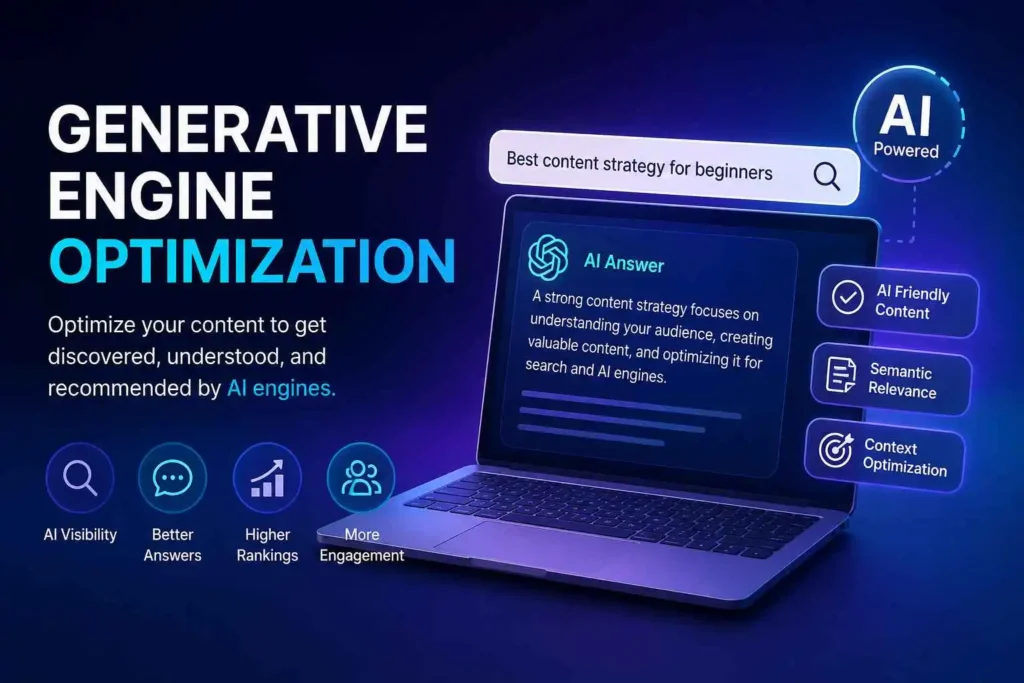
1.The mode We browse Has by now replaced
Why Content Creators Are Excited About GEO? Assume backward to how you used to look and object over on the internet
You’d open Google, click through a handful of websites, skim a few articles, maybe bookmark one or two, and eventually piece together an answer. That whole process could take ten or fifteen minutes easily.
Now? Most people just ask ChatGPT and get an answer in ten seconds.
That’s not a prophecy about destiny. That’s already developing, at present, on a daily basis. And if you appear who writes content for a living whether you operate a blog, lead a brand, or are self-employed for clients this shift is something you sincerely can’t afford to ignore.
Because if people are getting answers from AI instead of clicking on websites, where does that leave your content?
This is exactly why GEO is essential for content creators. Generative Engine Optimization (GEO) focuses on helping your content become the kind of trusted information that AI platforms can understand, reference, and recommend. As search continues to evolve, learning GEO isn’t just another marketing trend—it’s becoming an important skill for anyone who wants their content to stay visible in an AI-first world.
2. What GEO Means and Why It’s Different From SEO?
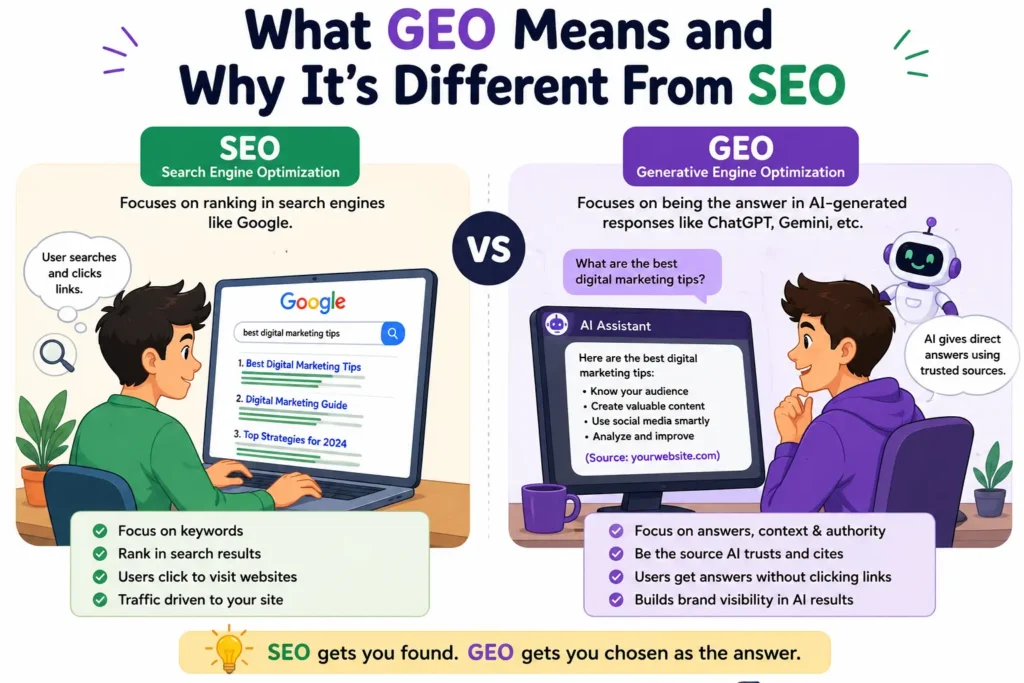
Here’s the simplest way I can explain it.
“SEO is about getting your content in front of people who are searching on Google. GEO is about getting your content trusted and referenced by AI tools when they’re building answers for users.“
Same destination, completely different road.
With traditional SEO, you focus on things like keywords, backlinks, and page speed. Those things still matter. But AI powered systems don’t really examine the content that way. These are not computing how many times you used a keyword. Those are asking a fundamental question: does this content actually explain something well? Does it cover the topic properly? Does it sound like a real person who knows what they’re talking about?
That’s a higher standard. And I’d argue it’s a more honest one.
3.Here’s What Most People Are Getting Wrong About AI Content
A lot of creators hear “AI is changing search” and immediately panic or dismiss it. Both reactions miss the point.
Here’s what’s actually worth understanding: AI tools don’t create knowledge on their own. They learn from content written by real people. When an AI gives someone a thorough, accurate explanation of something, it’s drawing from articles, guides, and research that humans wrote.
So your content doesn’t become irrelevant in an AI world. It becomes the raw material that the AI world runs on.
If your articles are well-written, accurate, and genuinely useful, they have a real shot at being part of the answers AI tools serve to millions of people. That’s a new kind of reach one that doesn’t show up in your page views but absolutely builds your authority over time.
The creators who recognize this now are building something real. Everyone else is going to be playing catch-up.
4. Why One Article Is Never Enough
I’ll be straight with you here because this is where a lot of people stall out.
Writing one good article on a topic doesn’t make you an authority on it. It makes you someone who wrote one article. There’s a big difference.
Real topical authority, the kind that readers trust and AI systems recognize, comes from covering a subject consistently, from multiple angles, over time. If you’re writing about GEO, you can’t just publish one overview post and move on. You need to go deeper.
Write about how GEO as a matter of fact differs from conventional SEO in practice. Cover what AI systems are sincerely looking for when they evaluate content. Talk about where content technique is heading and what that means for smaller makers competing with bigger brands.
When you build that kind of content ecosystem, something starts to happen. Each piece reinforces the others. Readers come back because they trust your take on things. And AI systems start treating your site as a reliable, knowledgeable source rather than just another page on the internet.
That kind of authority is slow to build. It’s also very hard to take away once you have it.
5.The One Advantage No AI Can Take From You?
I want to spend a minute on this because I think it’s genuinely underappreciated.
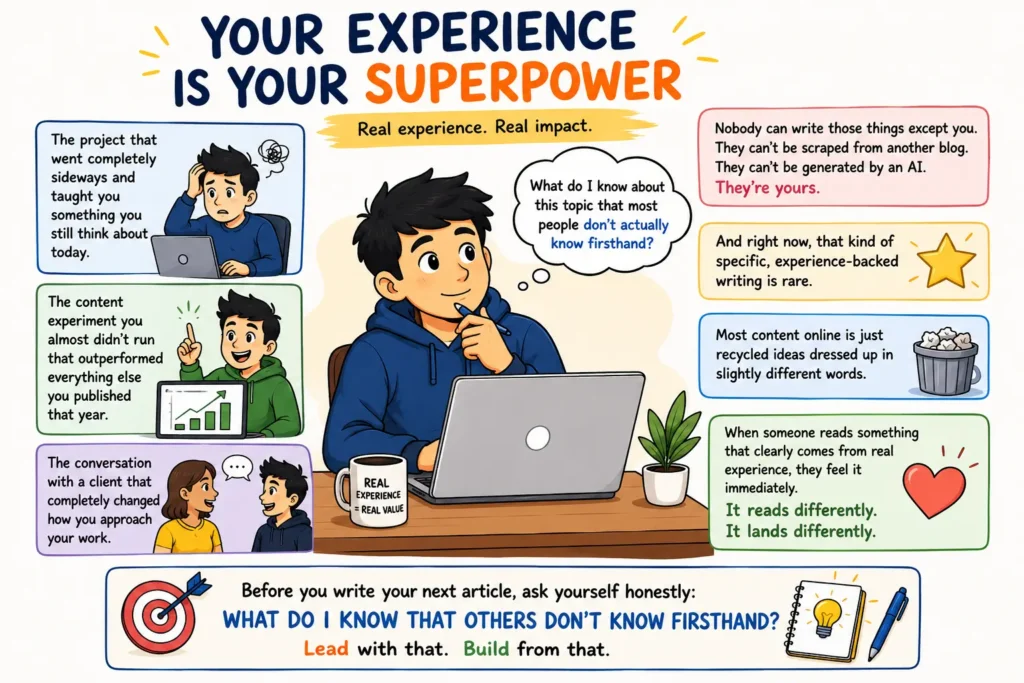
Your personal experience is the most valuable thing you bring to your content. Not your writing style. Not your SEO skills. Your actual lived experience.
The project that went completely sideways and taught you something you still think about today. The content experiment you almost didn’t run that outperformed everything else you published that year. The conversation with a client that completely changed how you approach your work.
Nobody can write those things except you. They can’t be scraped from another blog. They can’t be generated by an AI. They’re yours.
And right now, that kind of specific, experience-backed writing is rare. Most content online is just recycled ideas dressed up in slightly different words. When someone reads something that clearly comes from real experience, they feel it immediately. It reads differently. It lands differently.
So before you write your next article, ask yourself honestly: what do I know about this topic that most people covering it don’t actually know firsthand? Lead with that. Build from that.
6.Say the Thing Clearly and Say It Early
One reason people love AI assistants is that they get to the point. You ask a question, you get a direct answer. No four-paragraph warmup, no unnecessary filler, no burying the main idea at the bottom of the page.
Your writing should work the same way.
If you are writing about GEO, explain what GEO is in the first few passages. Don’t make viewers wade through a long presentation before they understand what they’re even reading. Respect their time. Give them what they came for, and then go deeper.
This isn’t just good writing advice. It’s also practical for GEO purposes. Content that’s easy to read is also easy for AI systems to process, summarize, and reference. Clarity helps everyone.
7. Habits That Slowly Destroy Your Credibility
Since GEO is having its moment, the rush to publish is real – and that’s exactly where credibility starts to slip. The habits that hurt you most aren’t dramatic mistakes, they’re quiet ones that build up over time:
- Publishing surface-level articles that add nothing new to the conversation
- Forcing keywords into sentences where they clearly don’t belong
- Putting your name on AI drafts you haven’t actually edited or fact-checked
- Writing to hit a keyword target instead of genuinely helping the reader
- Leaving outdated content sitting on your site without ever going back to it
None of this feels damaging at the moment. That’s the trap. Trust erodes slowly and rebuilding it takes far longer than losing it did.
8. SEO and GEO Aren’t Fighting Each Other?
Every time something new emerges in marketing, people rush to declare the old thing dead. It almost never works out that way.
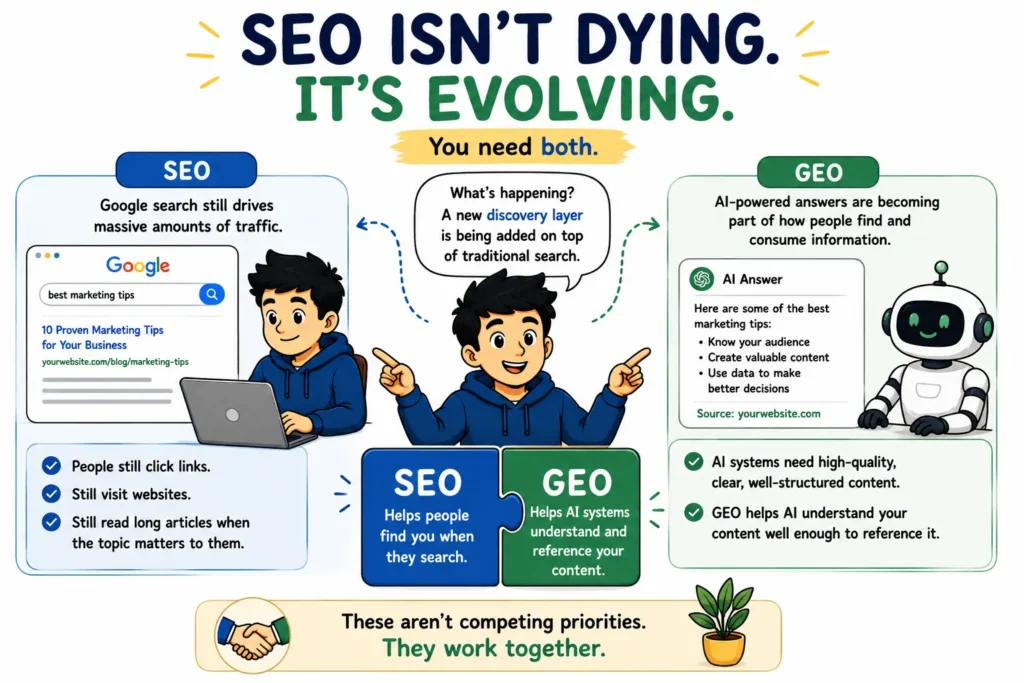
SEO is not dying. Google search still drives massive amounts of traffic. People still click links, still visit websites, still read long articles when the topic matters to them.
What’s actually happening is that a new discovery layer is being added on top of traditional search. AI-powered answers are becoming part of how people find and consume information. That’s not replacing search, it’s sitting alongside it.
So you need both. SEO helps people find you when they search. GEO helps AI systems understand your content well enough to reference it. These aren’t competing priorities.They work together.
9. What This All Comes Down To Why Content Creators Are Excited About GEO?
The way people find information is shifting. That’s real, it’s already happening, and it’s going to keep accelerating.
But here’s the thing that gets lost in all the noise about new tools and new strategies: the basics of good content have not changed. Write clearly. Share what you’ve actually experienced. Cover your topics with real depth. Show up consistently and be genuinely useful.
GEO isn’t a trick. It’s not a new way to game a system. At its core, it’s just a reminder that content worth reading is also content worth referencing by real people and AI systems alike.
That’s always been true. In 2026, it just matters in more places than it ever did before.